Work / Top-down action RPG · 2025
AuraRPG
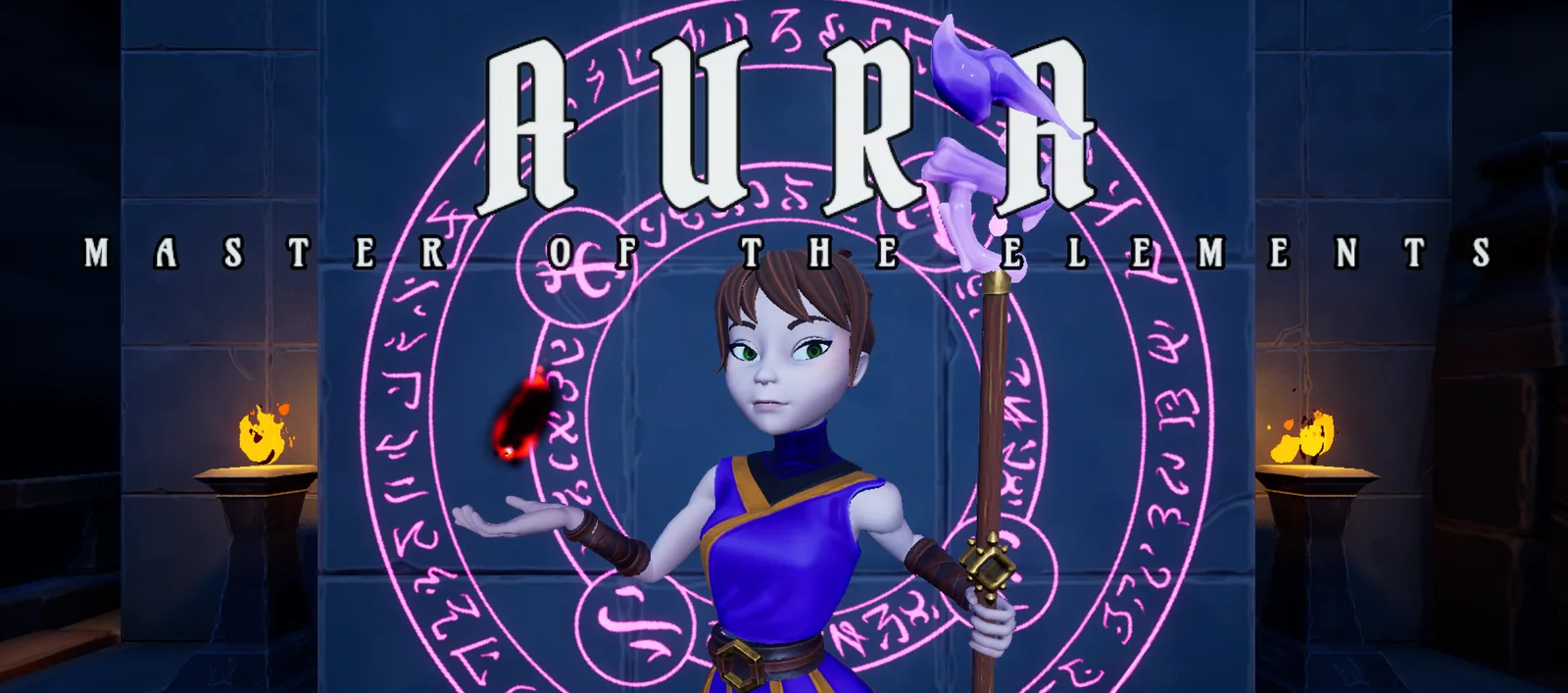
A top-down action RPG on Unreal's Gameplay Ability System: spells, attributes, enemy AI, save slots and a full UI, in C++ and Blueprints.
- Role
- Solo developer
- When
- Jan – Apr 2025
- Built with
- Unreal Engine 5.5 · C++ · Blueprints · GAS
- Platform
- Windows, Linux
- Status
- Playable demo · source on GitHub
- enemy variants in 3 classes
- 6
- spells: 4 offensive, 3 passive
- 7
- gameplay attributes
- 22
- native gameplay tags
- 72
Overview
The game
AuraRPG is a top-down action RPG in the style of Diablo. You click to move, cast fire, lightning and arcane spells from a hotbar, level up, spend points on attributes and new spells, and fight through goblins, shamans, demons and ghouls that each attack differently.
I built it while working through a long Gameplay Ability System course, as my way into Unreal's C++ side. The course targets Unreal 5.2; I built on 5.5, so a good part of the work was reading engine source and documentation to adapt what had changed. The demo levels at the end are my own.
Systems
What is in it
01
Ability system core
A custom UAuraAbilitySystemComponent and UAuraAttributeSet. Abilities are granted, levelled, equipped to input slots and unlocked by level, with their state tracked through gameplay tags (locked, eligible, unlocked, equipped).
02
Seven spells
Fire Bolt (projectiles that home and spread as it levels), Fire Blast (a ring of fireballs that go out and come back), Electrocute (a beam that chains to nearby enemies) and Arcane Shards (a targeted area spell with a magic-circle cursor). Three passives: Halo of Protection, Life Siphon and Mana Siphon.
03
Attributes and damage
Four primary attributes drive ten secondary ones through gameplay effects and custom modifier calculations. Four resistances, health and mana complete the set. All damage goes through one execution calculation.
04
Debuffs
Each damage type can apply its own debuff: burn, stun, and arcane and physical effects. The chance is reduced by the target's resistance, and the damage, frequency and duration ride along in a custom gameplay effect context that is serialised for the network.
05
Enemies
Six variants across three classes (warrior, ranger, elementalist): spear and slingshot goblins, demon warriors and rangers, ghouls, and a shaman that throws fire and summons minions. Behavior Trees pick the action; an EQS query finds ranged attackers a position with a clear shot.
06
Click-to-move
A short click builds a navigation path, turns it into a spline and auto-runs the character along it. Holding the button moves directly toward the cursor. The same cursor trace highlights enemies and interactable objects in different colours.
07
UI
Health and mana globes, XP bar, spell hotbar with cooldowns, attribute menu, a spell tree and floating damage numbers that show blocks and crits. Widgets never touch gameplay classes directly: three widget controllers broadcast changes to them, and the load screen uses Unreal's MVVM plugin.
08
Save and load
Three save slots. Checkpoints save the player's level, XP, attributes and abilities, plus the state of world actors flagged for saving, and the game resumes at the right map and player start.
09
Loot, spawns and demo levels
Enemies drop potions and crystals from chance-based loot tiers, and spawn volumes bring in waves as you enter an area. I added five showcase maps that walk a player through movement, checkpoints, levelling and enemy types, and end in a brawl arena with its own spawner class.
Step by step
What happens to a point of damage
Every hit in the game runs through UExecCalc_Damage, in this order.
Resist
Each damage type is cut by the target's matching resistance, 0 – 100%.
Fall off
Area spells scale by distance from the centre.
Block
A roll against block rate. A block halves the hit.
Armor
Armor, less the attacker's penetration, scaled by level curves.
Crit
Crit chance less the target's crit resistance. A crit doubles the hit and adds bonus damage.
The hard part
Following a 5.2 course on 5.5
Problem
The course was recorded on Unreal Engine 5.2 and I was on 5.5. Several systems, the Gameplay Ability System most of all, had breaking changes or deprecated nodes, and I was new to all of it.
Approach
Whenever the course and the engine disagreed, I went to the 5.5 documentation, the engine source, community forums and GitHub discussions, worked out what had changed, and rewrote that part of the C++ or Blueprint logic to match.
Result
A finished project on the newer engine, and practice at something that matters on long-lived codebases: working out what changed between versions and migrating code across it.
Gallery
Screenshots
Reception
What players said
Great game with many fun abilities. Last level was diabolical though :)
Note
Credits
The architecture follows the Udemy course "Unreal Engine 5 – Gameplay Ability System – Top Down RPG". Characters, environment pieces, particle effects, icons and sounds are the course's licensed assets. The showcase maps, the brawl spawner and the 5.5 port are mine.